Acupuncture with Teton Holistic Veterinary Care
Fine Needle and Vibrational Point Stimulation
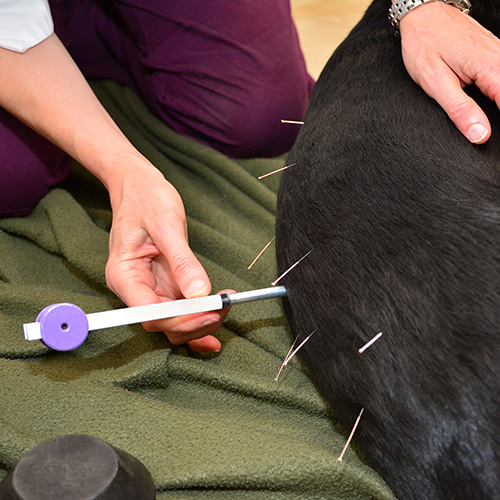
Acupoint Stimulation with Needles & Vibration
Acupuncture involves the placement of thin flexible needles (0.2-0.3 mm diameter) through the skin into superficial soft tissues (fascia and muscle). Needle placement is very specific according to ancient maps of the body surface, each point having a unique set of effects on both superficial and deep organs and tissues. Needles today are typically stainless steel with a copper, steel, or plastic handle; they are sterile single-use, discarded with the sharps. The number of needles used depends on the patient’s condition, with most point formulas ranging between 5 and 15 needles.
Areas of surface inflammation or infection are avoided, but acupuncture at appropriate points elsewhere can aid healing of such areas. Specialized tuning forks can also be used to vibrationally stimulate acupoints.
Western science has tried to isolate a specific mechanism of action to explain the effects of acupuncture. One theory is that the needles stimulate specific nerves which alter neural processing in the spinal cord and brain, changing the molecular signals that then go out to the rest of the body. This neurohormonal mechanism proposes that the effects of acupuncture are dependent on nerve stimulation alone, ignoring the classical acupuncture pathways called meridians. However, some studies in which the appropriate nerve was deactivated (either by chemical block or physical denervation) showed that acupuncture treatment still achieved its desired effects. The neurohormonal theory also has difficulty explaining other observations, including the multiple effects of stimulating a single acupuncture point and the distribution of many important points away from significant nerve pathways.
A competing theory, the electromagnetic mechanism, is based on the fact that most points studied have both lower electrical resistance and increased electrical conductivity than the surrounding skin. These properties vary depending on the disease state (with increased conductivity noted in points related to the diseased organ), physical activity, emotional state, time of day, and changes in the environment such as temperature and season. In the emerging science of bioelectromagnetics, it is known that the body’s electromagnetic (EM) fields regulate development and physiology; such EM fields are low-frequency and low-intensity, similar to those created during acupuncture treatment. The microcurrent generated as a metallic needle is inserted through the skin causes fluctuations in the patient’s EM field, likely altering this field in very specific ways depending on the points chosen. Such a non-molecular mechanism can affect the nerves (and the balance of molecules they release) but is not dependent on them, and early research suggests a correlation between the ancient meridian maps and modern EM field measurements.
Can any animal receive acupuncture?
- Yes! All species have acupuncture points and meridians.
- Some species and breeds are more sensitive to needling than others, so vibrational stimulation can be used instead.
- Care is taken to avoid needling points over delicate areas (e.g. over the air sacs of birds).
Can acupuncture be used to treat any ailment?
- Yes! There are points and meridians for every organ system and tissue in the body.
- Point formulas are designed to prioritize key concerns while assisting supportive tissues.
- Some ailments require special consideration. For example, points for cancer patients must be chosen to avoid increasing blood flow to malignant tissue.
How long are needles left in?
- Needle timing depends on the condition being treated and the condition of the patient.
- Smaller and more sensitive animals tend to process their needles faster.
- All needles are counted at the end of session, just like a surgeon counting lap sponges, to make sure none are left behind.
Because of its gentle and bodywide effects, acupuncture is worth considering in any patient!